Becoming Peter

Becoming Peter


“Master, then not only my feet, but my hands and head as well.” (John 13:9)

Over the course of Lent this year, I traveled around the county leading a retreat titled Surrender: Living Without Fear. It was about learning to let go and let God. I encouraged the women, through prayer and the sacraments, to do God’s will and trust Him, His Word, His authority, and His Divine guidance. It’s not an easy thing to do. Just look at the man who would become our first pope. He struggled with this more than anyone.

“God forbid, Lord!”

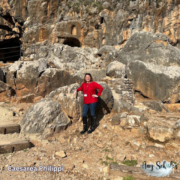
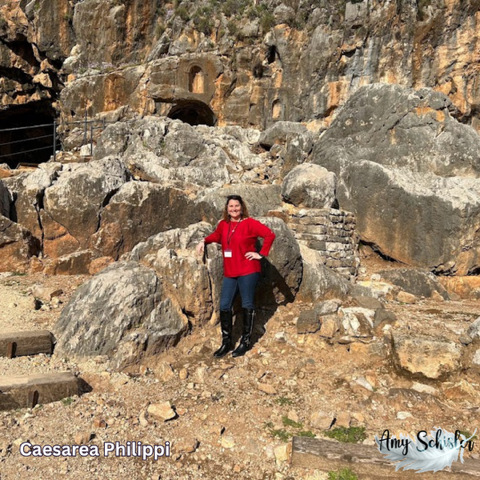
Back at Caesarea Philippi, just after Jesus declares Peter to be the rock on which He will build His Church, Peter displays his lack of understanding and refusal to follow God’s will. Jesus tries to get his disciples to understand that He must go to Jerusalem where He will suffer and be killed. Peter declares, “God forbid, Lord! No such thing shall ever happen to you” (Matthew 16:22).


How often do we do the same? How often do we look at God’s plan for our lives and declare, God forbid, I’m not doing that? We choose our own method and our own path, often leading to destruction of our souls.


“You shall never…”

In today’s Gospel for Holy Thursday, Peter rebukes Jesus when it comes time for his feet to be washed:

“’You shall never wash my feet.’ Jesus answered him, ‘Unless I wash you, you will have no inheritance with me.’ Simon Peter said to him, ‘Master, then not only my feet, but my hands and head as well.’” (John 13:8-9)

Once again, Peter believes he knows better than the Lord. Even when Jesus tries to tell Peter that he will understand in time why Jesus is doing this, what He is teaching them, Peter balks. Note here that Peter is referred to as Simon Peter in this exchange. He is still becoming the rock Jesus knows he will be.

How often do we balk when we don’t understand the Lord’s plan? So often, we think we know better than God, we know what’s right for us. We don’t always see the lesson He wants to teach us or the reason we must do what is asked of us. We fall back into our old habits, our old selves, forgetting to trust.


“I will not.”

St. Matthew tells us that Jesus predicted all his disciples would fall away once he was arrested, but

“Peter said to him in reply, ‘Though all may have their faith in you shaken, mine will never be. Jesus said to him, ‘Amen, I say to you, this very night before the cock crows, you will deny me three times.’ Peter said to him, “Even though I should have to die with you, I will not deny you.’” (Matthew 26:33-35)

Peter always had to have the last word. He knew what was best. He knew what Jesus should and should not do, and he knew what he would or would not do. He gave no thought to what the Lord was trying to tell him but relied on his own understanding and desires.

How often do we rely on our own understanding or desires? Even when others try to tell us the error of our ways or what God wants us to do, we choose to plow ahead, forsake the consequences, and proceed with pride instead of the humility it takes to follow God’s plan for us.


“You know that I love you.”

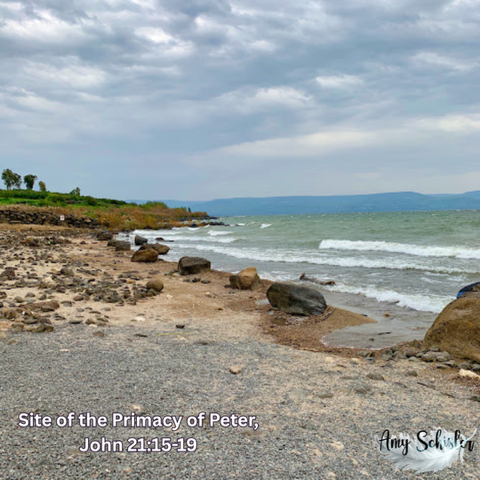
Despite all this, Jesus still had faith in Peter. He knew the man Peter would become even when Peter still had doubts. After the Resurrection, Jesus appears on the Sea of Galilee and invites the Apostles to sit down to eat with Him. He asks Peter — referred to throughout this passage as Simon Peter once again — three times if Peter loves Him. Our modern translation loses so much of the importance of this conversation. Jesus asks “Simon” twice if he loves Him with agape love, the kind of love willing to lay down his life for Jesus. Both times, Peter responds that he loves Jesus with philia, brotherly love. The third time, Jesus asks if “Simon” loves Him with brotherly love, and Peter responds, “Lord, you know everything; you know that I love you” (John 21:19). Then Jesus proceeds to tell Peter that one day, he will lay down his life for Jesus, displaying agape love. Simon would become Peter, the man capable of laying down his life for Jesus.


Like Peter, Jesus knows we often aren’t ready for whatever He’s asking of us. He knows that our journey of faith is a long one. When we disagree, balk, or deny, He doesn’t stop loving us. He knows that we are imperfect and can see only what is right before us. But He also knows that we can and will grow in our faith and understanding if we continue to follow Him.

Pray every day that you learn to trust in the Lord, to surrender your cares, worries, and your very life to Him. Know that He is waiting with open arms even when we think our choices are better than His. All of us, no matter our age, are still growing, still learning, still seeking the path God has laid out for us. We are all, at this time and still becoming, Peter.


Copyright 2026 Amy Schisler
Photos copyright 2026 Amy Schisler, all rights reserved.
Divine Calm in Life’s Storms

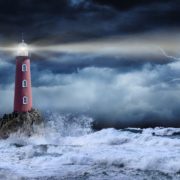
We encounter many kinds of storms as we journey through this world. For some, they are more destructive than for others. We naturally react with fear, and worry, and anger over why it must be this way. God knows we are passing through a fallen world, and He asks us to try and see things as He does, or to trust that He is in control and will guide us all the way.

As a psychotherapist, I work with clients who live in nursing homes. An elderly man, whom I will call Alex, recently said to me, “I grew up in a household of abuse, and I learned how to find peace as a result.”

Alex spoke of sustained years of physical abuse by his mother towards him, and to a lesser extent toward his younger brother. Alex learned over time to recognize how his mother was ill and wounded, that her battle was an inner one, and not truly aimed at or caused by him. With a series of questions and comments, I sought to deepen the exploration of how he had arrived at such a penetrating understanding.

“For a period of five years when I was growing up,” Alex said, “we had many soldiers who were returning from WWII stay with us at our house. They were each going to study at a Catholic seminary in Boston so they could become priests. Each one of them had seen battle and many horrors, and now each one of them wanted to serve God and serve others.”

“They could see that my mother was not in control of herself, and they would make it a point to take me and my brother out for walks. They would talk to us about the things they had seen and learned in battle.”

“I knew my mother was also in a battle and it was not really about me,” he continued. “I was a kind of collateral damage of her own damage.”

“I think that they helped me to see that I could find peace in myself even if I was in the midst of a battle. I mean, I don’t think that was what they meant, or what they were trying to say. They were just trying to get on with their lives, you know.”

“What I really believe is that God had touched me and sent me these soldiers to help me learn. They made such a difference for me.”

Alex offered examples of how he had been able to stay calm and avoid conflicts with peers in his adolescence, and also when he served in the Army.  Time and again others seemed annoyed, as well as mystified, by his peacefulness. “I think I was given a touch of the Divine, and I think that helped me to connect with a bit of that ‘peace that exceeds understanding,’ as it says in the Bible.” (1)

Over many years, I have worked with a great number of clients who have endured, or who are now enduring, the most severe types of life storms: disease, disfigurement, disability, abuse, abandonment, and countless disappointments, all dripping like raindrops from the branches of a barren and lonely tree.

Innumerable times, I have asked clients undergoing severe storms, “How do you survive? How do you cope?” More than ninety percent of the time, the person points an index finger upwards and says, “God.”

The providence of God surrounds all of the battles and storms of life, and He has placed a “touch of the Divine” in the deepest recess of our heart. We don’t reach that inner calm through the practice of human techniques, but by keeping our heart open even while caught in a storm, so that He might shelter and guide us, in His way. When a new storm intrudes into our life, we might wrongly assume it will now always be this way. But even though storms will arrive, they will also pass away, or we might simply find adequate bits of shelter and moments of peace to help us manage.

(1) “Let your gentle spirit be known to all people. The Lord is near. Do
not be anxious about anything, but in everything, by prayer and pleading with
thanksgiving, let your requests be known to God. And the peace of God, which surpasses
all comprehension, will guard your hearts and minds in Christ Jesus.’ (Philippians 4: 5-7)

Passing Gloom

Rain clouds rush in,
racing crowds from afar,
a meteor isobar.
Sky ripped wide with spears of fire.
Frightened eyes steal a secret peek,
To see who makes this darkness dire.

A towering titan appears to loom over startled rooms.
Drums of doom and fractured light
Send birds away in frightened flight.

Gone as quick as came,
The world outside seems the same.
Darkness breaks apart,
Bright sparkles everywhere dart.

Fragrant breezes flower with verdant bloom.
Gripped fears ease, dispelling passing gloom.

copyright 2026 Tom Medlar

Just Me and My Walking Stick

Just Me and My Walking Stick

He instructed them to take nothing for the journey but a walking stick–no food, no sack, no money in their belts. (Mark 6:8)

For years, I had a dream of walking on the routes of El Camino de Santiago (the Way of St. James), the pilgrim routes throughout Spain that lead to St. James’ burial place in Santiago. I knew there was little chance of that happening, but whenever the topic of the ancient route came up, I always said, “I want to walk that someday.” I never thought it would happen. Then one day …

Two by Two or Three

In 2022, I was planning a pilgrimage to the Holy Land for our parish, and our priest named some other places he wanted to visit. He had always wanted to walk El Camino, and I said I could look at that for 2024, but I was nervous. I honestly didn’t know any logistics about the walk, how long it would reasonably take, or which route would be the best. When I told a friend we were thinking about doing this, she said, “You cannot take a group on El Camino when you’ve never walked it yourself.”

I thought about that. She had a good point. It’s not like the Holy Land or France or Guadalupe, where I could just plan the trip and a guide would usher us from one religious site to another. This was a trek through the mountains, in the elements, walking many miles a day. I needed to know what this was like and if I was physically up to doing it myself.

Over lunch, I mentioned this to my friend, Angie, and she said, “I’ll go with you. Let’s do it.” We sat there, hovering over our phones, coming up with a plan. “There’s one catch,” Angie said, just as we decided to go for it. “If I go without my husband, he’ll be crushed. He’s always wanted to do this.”

So our pilgrimage of two on the Camino became a pilgrimage for three, and I was put in charge of making it happen.

Authority of Unclean Spirits

Fast forward about eighteen months. Chris, Angie, and I boarded a plane for Madrid with very large suitcases and oversized backpacks, ready to take on half the French Route. We had mentally, spiritually, and physically prepared for this trip for over a year. We had the right shoes, the right clothes, the water bladders, hiking socks, walking sticks, tons of snacks, evening wear for every night, supplies for making sandwiches, and everything anyone ever suggested. We were fully prepared.

However, that first night, after getting lost, missing dinner, and ending up at our hotel in the dark after walking almost twenty-five miles, I cried myself to sleep. There wasn’t a bone in my body that didn’t hurt. I already had blisters on my toes. I was physically and mentally drained, and it was only day one! I dreaded waking in the morning and telling Chris and Angie I couldn’t do this. It was too much.

I prayed for strength, courage, and guidance. I gave my pain and fears to the Lord, asking Him to help me do the right thing. I fell asleep as soon as I hit the bed, and something akin to a miracle took place. When I awoke in the morning, the first thing I did was pray an intentional Rosary, mentioning every person and prayer I’d taken with me. I showered and started packing my stuff, realizing I didn’t hurt. I had Compede for my blisters, and they seemed to be okay. I felt … ready.

Whatever worries I had were gone. I didn’t even think about them. All my despair from the night before evaporated like ether, floating away while I slept. I don’t think I gave a single thought to not continuing that day. Whatever doubts had plagued me a few hours before had been cast out like unclean spirits, and I felt renewed.


No Food, No Sack, Only Sandals

Over the course of the next two weeks, we had some amazing adventures. Every day, the world around us was more beautiful than the day before. Around each corner was a magnificent view. We watched a baby cow being born and waited around until he took his first steps. A vintner whose vineyard we were passing through offered us bunches of grapes to take with us (truly the best grapes I’ve had since sneaking them from my grandfather’s vines as a child). The pilgrim Masses each evening were inspiring. The food and wine were amazing. We became friends with Mina and her brother and sister-in-law, and are still in touch today. We met so many amazing people, from college students to pilgrims in their 80s and 90s.

The only thing still not working for us was all our stuff. We didn’t need nearly as many clothes as we thought we would. Guidebooks and extra toiletries made it hard to pack the small keepsakes we were collecting (an acorn from an elderly man who asked us to pray for him, a very small statue of Our Lady of the Oak, a beautiful stone on the path). We weren’t eating the multitude of snacks we brought, and our shoulders ached from the extra trail mix, granola bars, and sandwich fixings we never used.

Each morning, when we started from the hotel, our unused and unwanted items became the breadcrumbs we left behind. I even left my extra pair of hiking shoes when I became too tired of repacking every night and too tired of carrying them all day. I didn’t need them. By that time, I had so many blisters, I had resorted to wearing toe socks and Teva sandals every day. For eight days, I hiked in socks and sandals, not fashionable by any means, but my feet felt much better.

Shaking the Dust

Showering off the sweat and dust each evening became my favorite part of the day. Along with the dirt and dust of the hike, the waters washed away the pain, exhaustion, and any lingering fear or doubt. That time of showering and dressing became sacred for me, and even today, I say an intentional Rosary each time I shower, dress, and get myself ready for the day.

Just as the shower cleansed my body, that pilgrimage cleansed my mind and soul. I found that I actually enjoy a good long walk (which I never thought before). I realized, even in my fifties, I can do hard things. I can find God in the darkest places and hope in moments of despair. I enjoy praying the Rosary again (something I hadn’t done in years because it had stopped having meaning for me).


Driving Out Demons

When the man in the Pilgrim’s Office handed me my Compostela, I walked outside and burst into tears. I called my family and could barely speak. That first night, I didn’t think I could go another day. Thirteen days later, I felt like I could walk to the end of the world (still something I’d like to do at some point, but it’s another five days walk to Finisterra).

My body had fought a battle and won. I no longer doubt myself when faced with anything—sickness, pain, uncertainty, fear. I know I can make it through tough times, excruciating pain, or long, winding roads with no end in sight.

In 2024, I led a group of 29 pilgrims on the Portuguese Route. The challenges of leading a group (most of whom I did not know) were much different than walking alongside two dear friends. I still cried at night a time or two, but for different reasons. I found myself questioning why I had done this. But on the last day, I witnessed friends feel what I felt that first time. I saw a young woman and a senior citizen overcome their own fears and doubts to make it to the end. I cheered when the 85-year-old husband and wife completed their walk, inspiring our whole group.

I’m planning a 2027 walk on the English route. It won’t be a big group but a small collection of friends. I’ll be nearing sixty, but I know I can do it. I won’t need much for the journey other than my walking stick. I know the Holy Spirit will provide everything else.


Copyright 2026 Amy Schisler

Photos copyright 2026 Amy Schisler, all rights reserved.
The Prison Cook

The Prison Cook


Aidelade, the prison cook, was tough customer for this missionary in Oklahoma.

Today I am working in the prison kitchen with Adelaide.  We are making macaroni and cheese. She has a job here as a cook. I am here doing missionary work for my church and so I am helping her make the pasta.

Adelaide has a sharp tongue. I try to put some water from the pot into the pan with the onion.

“Not so fast,” says Adelaide. “You haven’t boiled the pasta yet, so no use in putting it there now.”

“Ok!” I said.  It is her mac and cheese for the prisoners. She is going to boil some water and put some pasta in it and fry the onion in oil. Then some pasta water and some milk. She will melt the cheese on a very low temp so it doesn’t curdle before mixing it with the pasta mixture.

Another time when I went, I thought of bringing some steak for the prisoners since they don’t get much quality food.  “Not so fast,” she said. “They get soybean stuff, not steak.”  There were several cans of “soybean stuff” laying around the kitchen.

They also get some greens.

“Adelaide, do you have family?” I asked.

“No,” she snapped. “That’s why I am here.”

“Do you ever go to church or read the Bible?” I ventured.

“NO. This is a prison. Do you want to help me make some Nutraloaf?” This is a loaf of various foods that is so disgusting it’s used as punishment.

“Adelaide, what would make you happy?”

She paused for a while and spoke slowly.

“When I was young, I wanted to be a chef at a nice restaurant. But that didn’t happen. I needed a job so I got the job here.”

“Why don’t you make a nice dinner here?”

“Who’s going to pay?” she answered.

“We can find a donor at my church. Do you think they would like coq au vin?”

We got the funds for the dinner and we got the shopping done.

Now it was time to cook!

“I’ll need your help,” she said. “This will be a lot of work.”

This is the recipe we used for the dinner (adapted from allrecipes.com).

Chef John’s Coq au Vin

6 bone-in, skin-on chicken thighs

kosher salt and freshly ground black pepper to taste

8 ounces bacon, sliced crosswise into 1/2-inch pieces

10 large button mushrooms, quartered

½ large yellow onion, diced

2 shallots, sliced

2 teaspoons all-purpose flour

2 teaspoons butter

1½ cups red wine

6 sprigs fresh thyme

1 cup chicken broth

Directions

Preheat the oven to 375 degrees F. Season chicken with salt and black pepper.

Sauté bacon in an oven-proof skillet over medium-high heat, until evenly browned. Remove bacon.

Increase the heat to high and cook chicken thighs 2 to 4 minutes per side. Transfer chicken to a plate.

Sauté mushrooms, onion, and shallots with a pinch of salt in the hot skillet until golden and caramelized, 7 to 12 minutes.

Stir in flour and butter.

Pour red wine into the skillet and bring to a boil. Stir in bacon and thyme and simmer until wine is about 1/3 reduced, 3 to 5 minutes. Pour in chicken broth and return chicken thighs to the skillet; bring to a simmer.

Transfer the skillet to the preheated oven and cook for 60 minutes or until temperature is 165 degrees F. Transfer chicken to a platter.

Thicken sauce in skillet then spoon over chicken.


We decided to serve it over noodles.

We brought it out and the prisoners formed a line as they normally did. When we uncovered the pot the prisoners gasped. The aroma was amazing. We served the food and the prisoners enjoyed it thoroughly.

© Copyright 2026 by Cecile Bianco

Mitzewich, John. “Chef John’s Coq au Vin.” All Recipes, last modified February 3, 2025, https://www.allrecipes.com/recipe/239230/chef-johns-coq-au-vin/

Elder is a Verb

Editor’s note: Technical issues are a nuisance, but in this case it is to our benefit because we revisit Margaret’s September column which disappeared into the ether, along with several other author’s works, due to website issues, now resolved, the latter part of the year.


“… It was not you who chose me, but I who chose you and appointed you to go and

bear fruit that will remain …”  — John 15:16

“Now is the season of the fruiting and the dying.”  — Mary Dingman, SSSF


Elder is a Verb

My long-time spiritual director, Sister Mary Dingman (1919-2017), a vowed member of the School Sisters of St. Francis, was the first person from whom I heard the words, “elder is a verb.”

Sister Mary served her order with distinction as novice mistress, postulancy mistress, Catholic high school teacher, provincial coordinator, and formation director in multiple settings, from the Archdiocese of Milwaukee to the Archdiocese of Omaha. (1)

An apocryphal story tells that while she was still a novice herself, Mary refused a demand to sit in the back seat, from her brother’s fellow seminarian who was giving her a ride back to the convent from their rural hometown.

He was afraid of being seen with a female in his automobile. Novice Mary climbed straight into the front passenger seat. She didn’t recognize any difference in moral responsibility among disciples of the Lord, only different roles to fulfill.

Sister Mary was already a recognized religious figure in her own right by the time her older brother, Bishop Maurice Dingman (1914-1992), called her back to their home state of Iowa.  He asked her to support and assist the Jesuit priests who served Emmaus Community prayer house, to extend opportunities for professional spiritual direction beyond the clergy and into the wider Des Moines lay community.

For more than twenty years, Mary Dingman, SSSF served as a spiritual director at Emmaus House, in a historic Victorian two-story home located close the inner city. She prepared daily lunches where everyone was welcomed to the feast in her beautifully set dining room, after liturgy and Eucharist were offered in the home’s cozy living room. Mass was celebrated there for many years by one of the Jesuit or diocesan priests, as simply and profoundly as the earliest Christians celebrated in the catacombs. Later, centering prayer groups and holy day dinners joined the schedule as the Emmaus community grew.

Sister Mary hosted Catholic and Protestant clergymen, vowed religious, and laypersons for private retreats in the small bedrooms upstairs, providing three excellent meals a day along with plenty of quiet time and peace to enjoy the gardens that surrounded her home. She was still driving, by herself, around the state to provide directed retreats at monasteries and convents, into her late eighties.

Sister Mary Dingman fulfilled her commission as an apostle proclaimed by Jesus in the Gospel of John: to bear fruit that would last.

Emmaus House maintains its commitment to Ignatian Spirituality and community fellowship in the Diocese of Des Moines, even to this very day; offering educational conferences, group and private retreats, as well as personal spiritual direction, now from a new home that is better-equipped to utilize modern technology. (2)

What about us?

As the Autumn Equinox arrives this Monday, September 22, where do we find ourselves? Probably most members of the Catholic Writers Guild are attending Mass regularly, and making strong efforts to educate their families in the faith.

We might not want to think too much about our own deaths, but are we still living our faith to its fullest?

According to the United States census, all members of the United States “Baby Boom” population, people who were born between 1946 and 1964, will not reach the current “retirement” age of 65 until 2030 (3).

“Independent living communities” for “senior citizens” have been popping up like mushrooms all over the country for decades, and many have long wait lists as well as hefty fees. Busy families with active young children and teenagers are too often forced to beg, in some places, to find a single bed available in a skilled nursing home with adequate facilities to help them care for aging parents.

How many devout and aging Catholics do we know, who are facing difficult choices for their final years?

The Oxford English Dictionary gives three parts of speech for the word “elder”:  noun, adjective, and verb – which is offered third in order, after the noun and the adjective, because it is the least common usage.

“1. verb trans. With it, to play the elder. rare. …”

“2. verb intrans. Become older, begin to show signs of age. colloq. and poet. …”

“3. verb trans. Make a request to or admonish a person …” (4)

But none of these were what my friend Sister Mary meant, nor how she lived her own life. She spoke with an active verb, and went about “eldering” with her whole self.

Are we thinking too much about the leaves falling and dreading winter? Are we approaching our own “autumns” as fates to “die” rather than to “fruit”?

Many older people in our society are struggling to afford food on limited social security payments. Children in schools often need surrogate grandparents to listen to their reading and tell them stories, when parents may be too busy or too overwhelmed.

Families, parishes, and dioceses offer plentiful opportunities to help with food pantries, assist the ill or handicapped, offer constructive personal attention to children.

Perhaps most important, “Baby Boomers” who have already retired and those who will retire over the next three decades are the last generation on earth who will remember a culture, and a quality of human life, before demands and consequences of administration by computer.

We can leave an imprint of real experiences in direct and human interaction with the generations that will follow us.

The saints in heaven watch over us as we drag ourselves out of bed, perhaps groaning with arthritic pain. They listen to and intercede for our prayers on behalf of our ancestors, neighbors, children, and grandchildren. They see us picking up our glasses, hearing aids, keys, canes, or walkers, putting on our coats and boots, going out to take care of our daily business.

No matter our circumstances, we can move forward into this autumn of 2025 — even as our earthly weather starts progressing towards winter – carrying the fruits of love, hope, and genuine encounters that endure.


© 2025 by Margaret King Zacharias

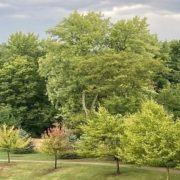
Feature photo: First Color in Iowa – Photo Credit Margaret Zacharias. Published with permission.

Inset photo: Autumn Rainbow to Heaven – Photo Credit Charles Zacharias.  Published with permission.


Notes

  1. https://www.barrmemorialchapel.com/obituary/4352175
  2. https://www.theemmaushouse.org/about-us
  3. https://www.census.gov/library/stories/2019/12/by-2030-all-baby-boomers-will-be-age-65-or-older.html
  4. Shorter Oxford English Dictionary, Fifth Edition, Volume I A-M, Oxford University Press, Great Clarendon Street, OX2 6DP, Published in the United States by Oxford University Press Inc, New York, 2002, p. 801.

The Intermediate Steps

Editor’s Note: We lost Jane’s December reflection due to website issues — now resolved — but can enjoy once again reading about the inspiration for her story that appears in the Catholic Writers Guild’s first anthology, Pilgrim Tales. 

The Intermediate Steps

How do you send an angel on a pilgrimage?

That was my first thought on reading the subject of the Catholic Writers Guild anthology, and no answer presented itself. I love writing about angels (ten of my books feature angels as main characters) and I would have jumped at the chance to write another one here.

Being pure spirits, angels are understood to move between Point A and Point B without traversing the intermediate space. You’re at 83rd and Park but want to see the ducks at Choate Pond Park? There you are. A friend calls for help? You’re immediately on hand. (Well, not “on hand” if you’re a pure spirit, but I’m human, and, well …)

A pilgrimage for an angel would go something like, “Well, I’m here. Cool.” I wasn’t getting five thousand words out of that.

An angel would, however, have to traverse the intermediate space if he were accompanying someone else who had to, though. So … a guardian angel of a human.

Even so, pilgrimages imply a spiritual journey as well as a physical journey. We accept that angels aren’t perfect (Job 4:18), and since God is mysterious and beyond even an angel’s comprehension, of course an angel would always be delighted to learn more about Him. For a creature who’s existed for thousands of years, though, conditions would have to be extreme to reveal a new aspect of God, or to draw him closer to God in a way he’d never needed to before.

And that’s why I sent my angel to Purgatory.

“Way Stations” begins with a guardian who’s still shaken by his charge’s last hours and the stress of her judgment. She’s saved, but she’s in Purgatory. She’s also “secluded,” meaning she can’t sense her own guardian. The Purgatory angels assure him she’s safe, and he can leave, but he refuses. He’s not leaving her side until she enters Heaven.

Purgatory is a wasteland, and his charge starts walking.

The angel, who up until now was secure in his identity and his job and his work, walks with her. For the first time, he feels useless and stalled out, and it’s in that position that he sees how his charge’s soul begins to respond to the Holy Spirit. It’s not easy.

I say, “But I’m not the one in Purgatory.”

“Look around.” The other angel snickers. “Traveling? Struggling? You most definitely are in Purgatory.”

Of course an angel would never sin, nor want to sin, but I suspect it’s possible to get “stuck” in one way of relating to God. Everything can be “good enough.” Except God isn’t interested in “good enough.” He wants all of us, and sometimes, that may mean taking a journey you never intended, through all the intermediate steps — even for an angel.

© Copyright 2025 by Jane Lebak

Feature photo: https://docs.google.com/document/d/1RCk-dg0blH4Z1O0BOv1JSSVEYau71gvYTB2MqOR9Wr0/edit?usp=sharing

Review of The Miracle Book by Anthony DeStefano

We all need a miracle at some point. In the “season of miracles” here is some guidance
on asking for one.

“What matters is that you desire something badly. And
this time it’s serious. This time you mean business. This
time you need supernatural assistance, and you need it
now.” – (DeStefano 2025, 2)

We often hear Christmas described as the “season of miracles,” and it is. The birth of our Savior was the greatest miracle in history until His Resurrection. The Holy Family’s survival from threats, obstacles, and dangers at the time of His birth was guided only by angels and the hand of God. But that’s not what the commercials refer to when a little girl opens a beautifully wrapped box to find the doll she’s begged for all year. It’s not the snow coming down on a perfectly decorated Victorian inn on Christmas Eve in the typical holiday Romcom. Miracles, like angels, have been sentimentalized and trivialized in popular culture and oftentimes, God is taken out of the whole scenario. It’s only appropriate to attempt to right that ship this time of year.

In his 2025 release, The Miracle Book: A Simple Guide to Asking for the Impossible (Sophia Institute Press), Anthony DeStefano tackles the topic. The author of 30 titles that address, among other subjects, getting to heaven, handling anxiety, and navigating Atheist thinking, he has also produced some of the most beautifully written and illustrated faith-centered children’s books on the market that, quite frankly, could be enjoyed at any age. Anyone who has read Mr. DeStefano’s books or listened to his interviews knows he states his case clearly.

He’s a no-nonsense kind of messenger.

In this book on asking God for a miracle, which is devoid of touchy-feeling sentimentality and superstition and filled with reason and spirituality, he looks the reader in the eye, takes him by the shoulder and sits him down to tell him what’s what. The author reckons that anyone reading his book needs something that is beyond their reach, and they are looking to God for some hefty help. He also assumes that, on some level, everyone believes in a miracle; it’s not a Catholic or Christian thing. Atheists and agnostics all need and ask for miracles at some point in their lives.

But what guidance can you realistically give about asking for something so abstract and supernatural? And so big. Surprisingly, some practical advice imparted in a highly pragmatic manner.

First, you need to understand what you are asking for – what is a miracle, what isn’t. The author offers three perceptions of a miracle. Understanding his perspective is the key to following Mr. DeStefano’s process. You can muster up all the faith and fervor within you, but God’s will may not be in line with your expectations. Still, he believes you can strengthen the possibility but understand, “… obtaining a miracle is both easy and difficult and that it involves a mysterious, divine paradox …” (DeStefano 2025, 4).

He returns to the concept of paradox throughout the book, tying it into the miracle premise. You must, however, put in the work and that involves being spiritually fit, for which Mr. DeStefano is your coach. Remember, he wants you to succeed because it’s not just about God giving you a miracle. It’s about the intimacy you and God ultimately share. It’s about Him knowing just what your soul longs for beyond your immediate request. It’s a certainty on your part that He’s there living inside of you and taking care of you. Coach DeStefano is on the outside, toning your spiritual muscles. His approach is as simplified as it possibly can be without losing any depth. He explains and encourages by referencing miraculous events and citing Scripture, such as the “miracle promises” God makes in the person of Jesus Christ in nine passages from the Gospels (DeStefano 2025, 34-36). He counsels you, when you are tired and afraid, of the truth that God is with you and wants to help you. He warns you of potential pitfalls and how to avoid them, digging into anxiety and feelings, how they can get the better of you, and how that can derail your progress.

Regardless of their unpredictability, moods and emotions can open a window for Satan to come in.

“Don’t underestimate the devil’s grasp of this phenomenon. He’s very adept at exploiting our feelings. Indeed, one of his most effective strategies is to convince us to act based on our emotions rather than on reasoned decisions” (DeStefano 2025, 88).

When it seems like you’re hitting a wall, he reminds you of the Mass and the Eucharist and of the intercession of the Blessed Mother. When you’ve completed your basic training, he sends you off with more prayers and the hope of good things to come. If this sounds too lighthearted for your miracle, you would be wrong. Remember, Mr. DeStefano said at the beginning that if you are reading his book, you or someone you love has a deep and heavy issue. He presents some hard examples: the death of a little girl who had countless prayers, and even his own prayers for his ill father. With his help and trust in God, you begin to have a glimpse of your request from the perspective of the Divine, rather than your own limited vision. And you begin to understand and trust that God will provide.

Featured image AI generated in Adobe Firefly with Google Gemini Nano Banana
© Copyright 2025 by Mary McWilliams


Edited by Rietta Parker

True Strength

“Put your sword back into its place; for all who take the sword will perish by the sword. Do you think that I cannot appeal to my Father, and he will at once send me more than twelve legions of angels? But how then would the scriptures be fulfilled, which say it must happen in this way?”—Matthew 26:52b–54 (NRSVCE)

Jesus could’ve stopped it.

He’s the Son of God, God Himself, the most powerful being ever to exist. He walked on water, made enough food for hundreds out of a few loaves and fish, healed countless illnesses, and cast out demons. He knew Judas was going to betray Him, knew the Pharisees were sending soldiers to arrest Him. Knew He was going to die.

Jesus could’ve called down legions of angels, raised a hand and struck all his enemies blind or worse, or even simply hid where He knew they’d never find Him.

But He didn’t.

Instead, He let the high priest arrest Him, let the Pharisees mock and accuse Him, let the crowds scream for His execution, let the Romans humiliate, torture, and kill Him.

He chose not to fight against His enemies but for them. Chose not to condemn us to the death and punishment we deserve but to take it upon Himself.

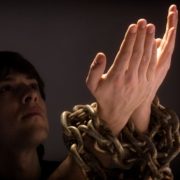
That’s true strength. Not strength of mind but strength of will. Not strength of body but strength of heart. The strength to be free, even in chains. The strength to endure. The strength to forgive.

The strength to love.

And it’s that love—that strength—that Jesus calls each one of us to as well.


© Isabelle Wood 2025

Edited by Gabriella Batel

Photo copyright Canva

The Shepherd’s Pie: Grief and Conversion

The Shepherd’s Pie: Grief and Conversion

“A slice of hope to raise faithful kids.”

This uplifting, ecumenical show uses engaging conversations and fun entertainment reviews to offer positive insights and media resources for families and youth leaders. We discuss current issues that impact young people at home, in school, and in the world today.

In this episode of The Shepherd’s Pie, I speak with Wendy Forest about her experience as a widow, and how grief led to her conversion to the faith, and we discuss her spiritual reflection, Currents of Water: A Widow’s Walk with Jesus and Mary.


Check out other episodes of The Shepherd’s Pie.


Copyright 2025 Antony Barone Kolenc

Shattered Rocks on Solid Ground

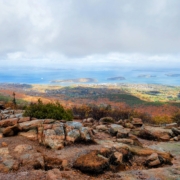
While hiking the North Ridge Trail on Cadillac Mountain at Acadia National Park, my daughter and I paused on a rock mound, breathing in the chill wind and the vibrant red, yellow, and green hues of Autumn. As we sat, Sheila commented on the solid, secure sensation emanating upward from the mountain depths. Peace flooded through me, and now I am reminded of the solid ground on which my faith was built. 

That one is like a man building a house, who dug deeply and laid the foundation on rock; when a flood arose, the river burst against that house but could not shake it, because it had been well built. Luke 6:48

“Mama, close your eyes and listen.” Sheila quietly instructed. When you are on the mountain, the wind moving through the trees sounds like the ocean waves rushing to shore. Except for the cold, with eyes closed, you could very well be at the beach where endless shells break under crushing surf.  But the mountain rock is immovable, its pink and gray and green granite boulders stand firm after countless millennia of glacial pounding. Solid as it is, the mountain harbors millions of shattered rocks along the trail, broken pieces huddled together beneath the massive outcrop where we sat.

I thought about a poem I wrote (see “Broken Shells” August 10, 2025 blog post https://www.catholicwritersguild.org/2025/08/broken-shells/) and the similarity of those shells and shattered rocks – so many pieces, each unique and beautiful despite their brokenness. Each forms a part of the whole. Each can fulfill its purpose on the canvas when there is a foundation in the Lord.  Whether at a beach or atop a mountain, whether we hear waves or wind, He is our solid ground.

“The Lord is near to the brokenhearted and saves the crushed in spirit.” Psalm 34:18

That day on the trail, I was overcome with the beauty of God’s creation and thankful for His love and care for us. The picture I took (above) is only a small glimpse of what I experienced, and my heart sings with the praise of Psalm 104:1-5:

“Bless the Lord, O my soul. O Lord my God, you are very great. You are clothed with honor and majesty, wrapped in light as with a garment. You stretch out the heavens like a tent, you set the beams of your chambers on the waters, you make the clouds your chariot, you ride on the wings of the wind, you make the winds your messengers, fire and flame your ministers. You set the earth on its foundations, so that it shall never be shaken.”


© Copyright 2025 by Paula Veloso Babadi

Feature Photo North Ridge Trail, Cadillac Mountain, Acadia Nati onal Park by Paula Veloso Babadi, used with permission.

Scripture texts in this work are taken from the New American Bible, revised edition © 2010, 1991, 1986, 1970 Confraternity of Christian Doctrine, Washington, D.C. and are used by permission of the copyright owner. All Rights Reserved.

Stay in the Know

Join Our Newsletter

Members and supporters can get the latest on CWG news and events by signing up for our newsletter.

Please wait...

Thank you for signing up!

Catholic Writers Guild
P.O. Box 77
Eaton, IN 47338