
Divine Calm in Life’s Storms

We encounter many kinds of storms as we journey through this world. For some, they are more destructive than for others. We naturally react with fear, and worry, and anger over why it must be this way. God knows we are passing through a fallen world, and He asks us to try and see things as He does, or to trust that He is in control and will guide us all the way.

As a psychotherapist, I work with clients who live in nursing homes. An elderly man, whom I will call Alex, recently said to me, “I grew up in a household of abuse, and I learned how to find peace as a result.”

Alex spoke of sustained years of physical abuse by his mother towards him, and to a lesser extent toward his younger brother. Alex learned over time to recognize how his mother was ill and wounded, that her battle was an inner one, and not truly aimed at or caused by him. With a series of questions and comments, I sought to deepen the exploration of how he had arrived at such a penetrating understanding.

“For a period of five years when I was growing up,” Alex said, “we had many soldiers who were returning from WWII stay with us at our house. They were each going to study at a Catholic seminary in Boston so they could become priests. Each one of them had seen battle and many horrors, and now each one of them wanted to serve God and serve others.”

“They could see that my mother was not in control of herself, and they would make it a point to take me and my brother out for walks. They would talk to us about the things they had seen and learned in battle.”

“I knew my mother was also in a battle and it was not really about me,” he continued. “I was a kind of collateral damage of her own damage.”

“I think that they helped me to see that I could find peace in myself even if I was in the midst of a battle. I mean, I don’t think that was what they meant, or what they were trying to say. They were just trying to get on with their lives, you know.”

“What I really believe is that God had touched me and sent me these soldiers to help me learn. They made such a difference for me.”

Alex offered examples of how he had been able to stay calm and avoid conflicts with peers in his adolescence, and also when he served in the Army.  Time and again others seemed annoyed, as well as mystified, by his peacefulness. “I think I was given a touch of the Divine, and I think that helped me to connect with a bit of that ‘peace that exceeds understanding,’ as it says in the Bible.” (1)

Over many years, I have worked with a great number of clients who have endured, or who are now enduring, the most severe types of life storms: disease, disfigurement, disability, abuse, abandonment, and countless disappointments, all dripping like raindrops from the branches of a barren and lonely tree.

Innumerable times, I have asked clients undergoing severe storms, “How do you survive? How do you cope?” More than ninety percent of the time, the person points an index finger upwards and says, “God.”

The providence of God surrounds all of the battles and storms of life, and He has placed a “touch of the Divine” in the deepest recess of our heart. We don’t reach that inner calm through the practice of human techniques, but by keeping our heart open even while caught in a storm, so that He might shelter and guide us, in His way. When a new storm intrudes into our life, we might wrongly assume it will now always be this way. But even though storms will arrive, they will also pass away, or we might simply find adequate bits of shelter and moments of peace to help us manage.

(1) “Let your gentle spirit be known to all people. The Lord is near. Do
not be anxious about anything, but in everything, by prayer and pleading with
thanksgiving, let your requests be known to God. And the peace of God, which surpasses
all comprehension, will guard your hearts and minds in Christ Jesus.’ (Philippians 4: 5-7)

Passing Gloom

Rain clouds rush in,
racing crowds from afar,
a meteor isobar.
Sky ripped wide with spears of fire.
Frightened eyes steal a secret peek,
To see who makes this darkness dire.

A towering titan appears to loom over startled rooms.
Drums of doom and fractured light
Send birds away in frightened flight.

Gone as quick as came,
The world outside seems the same.
Darkness breaks apart,
Bright sparkles everywhere dart.

Fragrant breezes flower with verdant bloom.
Gripped fears ease, dispelling passing gloom.

copyright 2026 Tom Medlar

The Intermediate Steps

Editor’s Note: We lost Jane’s December reflection due to website issues — now resolved — but can enjoy once again reading about the inspiration for her story that appears in the Catholic Writers Guild’s first anthology, Pilgrim Tales. 

The Intermediate Steps

How do you send an angel on a pilgrimage?

That was my first thought on reading the subject of the Catholic Writers Guild anthology, and no answer presented itself. I love writing about angels (ten of my books feature angels as main characters) and I would have jumped at the chance to write another one here.

Being pure spirits, angels are understood to move between Point A and Point B without traversing the intermediate space. You’re at 83rd and Park but want to see the ducks at Choate Pond Park? There you are. A friend calls for help? You’re immediately on hand. (Well, not “on hand” if you’re a pure spirit, but I’m human, and, well …)

A pilgrimage for an angel would go something like, “Well, I’m here. Cool.” I wasn’t getting five thousand words out of that.

An angel would, however, have to traverse the intermediate space if he were accompanying someone else who had to, though. So … a guardian angel of a human.

Even so, pilgrimages imply a spiritual journey as well as a physical journey. We accept that angels aren’t perfect (Job 4:18), and since God is mysterious and beyond even an angel’s comprehension, of course an angel would always be delighted to learn more about Him. For a creature who’s existed for thousands of years, though, conditions would have to be extreme to reveal a new aspect of God, or to draw him closer to God in a way he’d never needed to before.

And that’s why I sent my angel to Purgatory.

“Way Stations” begins with a guardian who’s still shaken by his charge’s last hours and the stress of her judgment. She’s saved, but she’s in Purgatory. She’s also “secluded,” meaning she can’t sense her own guardian. The Purgatory angels assure him she’s safe, and he can leave, but he refuses. He’s not leaving her side until she enters Heaven.

Purgatory is a wasteland, and his charge starts walking.

The angel, who up until now was secure in his identity and his job and his work, walks with her. For the first time, he feels useless and stalled out, and it’s in that position that he sees how his charge’s soul begins to respond to the Holy Spirit. It’s not easy.

I say, “But I’m not the one in Purgatory.”

“Look around.” The other angel snickers. “Traveling? Struggling? You most definitely are in Purgatory.”

Of course an angel would never sin, nor want to sin, but I suspect it’s possible to get “stuck” in one way of relating to God. Everything can be “good enough.” Except God isn’t interested in “good enough.” He wants all of us, and sometimes, that may mean taking a journey you never intended, through all the intermediate steps — even for an angel.

© Copyright 2025 by Jane Lebak

Feature photo: https://docs.google.com/document/d/1RCk-dg0blH4Z1O0BOv1JSSVEYau71gvYTB2MqOR9Wr0/edit?usp=sharing

Broken Shells

Broken Shells

by Paula Veloso Babadi

“The Lord is near to the brokenhearted and saves the crushed in spirit.”—Psalm 34:18

I recently spent a day with some family on the beach at Daytona. Although it’s the “dog days” of summer, we were blessed with a light breeze, refreshing salty air, and cold waves. We enjoyed a terrific time together.  

I believe sand and sea are God’s healing gifts, and I am reminded of a December day over 30 years ago.  My husband and two young sons enjoyed lunch with a family friend at his home on the shores of Ponte Vedra Beach. As my sons ran off looking for sharks’ teeth and my husband chatted with his friend, I ventured beyond the graceful French doors that opened onto the ocean. Amid inhaling the crisp salt air and reveling in the cool breeze, I felt a twinge of sadness as I eyed the broad expanse of broken shells before me. How much we humans are like these shells—huddled together, separate, yet one on the canvas of creation.

Today, along miles of shoreline, there still are jewels, brushed and polished by the repeated breaking of waves and warmed to a glow by sunshine on clear (and even cloudy) days. Even though life is good, that day, I felt broken inside, just like the shells. But as the sun warmed my arms, I knelt to take a closer look. Our wise Creator gifted me with the hope of repurpose and repair, and the vision of being whole in Him. Whether crushed or damaged, we are part of His perfect painting: His polished masterpiece.  That vision gave me hope, then and now, and inspired the poem I wrote below.


Broken Shells

by Paula Veloso Babadi


Broken shells upon the shore

washed in by gentle waves once more,

paint the sand with shattered dreams—

their beauty lost in fragments.


One masterpiece in the array,

amidst the broken pieces lay

too well concealed for me to see

its beauty on the canvas.


Though I am broken-pieced this day,

God’s healing sun and ocean spray

brush me into a form anew

whole again amidst the broken shells.


Copyright Paula Veloso Babadi 2025

Edited by Gabriella Batel

The Meaning of Life: Part 1 of 3, An Introduction

“Live the present moment, filling it to the brim with love” (Cardinal Francis Xavier Nguyên Van Thuân, Five Loaves and Two Fish).

In the midst of ongoing world crises — wars in Ukraine and Gaza, economic uncertainty, and the loss of our Pope — there remains the desire to celebrate, to hope, to live, even as we mourn the Pope’s death.

As we Catholics ponder the future and await with joyful hope during this time of Sede Vacante, we celebrate the life of a good man who has gone home to the Lord, we have hope for the future, and we live each day awaiting news of our next shepherd.

Over the past three weeks, there has been a great outpouring of love for our Holy Father on Earth. He emulated our Lord as a man of mercy and compassion (“As he went ashore, he saw a great crowd; and he had compassion for them,” Mark 6:34). He understood Jesus’ call for mercy (“A bit of mercy makes the world less cold and more just,” March 17, 2013 First Angelus of Pope Francis). He was a man of great love for all people (“You shall love your neighbor as yourself,” Mark 12:31).

Pope Francis, a man who lived like Jesus lived, taught what Jesus taught, and loved like Jesus loved, was beloved and adored the world over because he knew the meaning of life. What did he know that we should know? How can we discover the meaning of life?


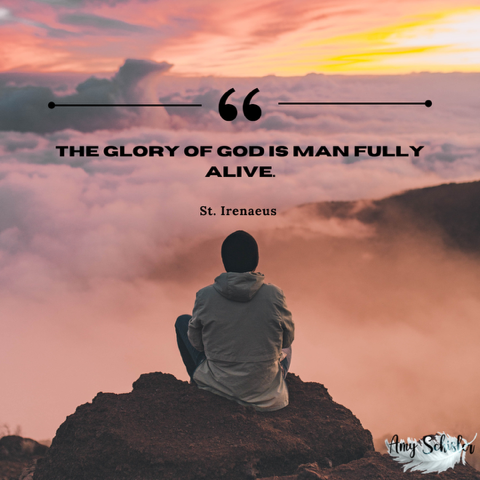
The glory of God is man fully alive

Fully Alive

Like Pope Francis, we are called to have mercy and compassion. We are called to love. We are called to be fully alive. This is the thing for which we are all searching — to be fully alive. And we can only get there through the acts of mercy, compassion, and love.

Our associate pastor, Father Michael Angeloni, recently gave a homily where he showed us the difference between mercy and compassion. He said that having compassion is feeling bad about someone’s circumstance or wishing better for someone; whereas showing mercy is taking action to help someone or make things better for them. Jesus had compassion, but he acted with mercy. Acting with mercy leads us to a deeper love of others.

People who understand this difference know the meaning of life. These people know that following Christ’s example and moving beyond trepidation and fear will lead us to living more fully. People like Pope Francis who said,

“Cast out the fears that paralyze you, so that you don’t become young mummies. Live! Give yourselves over to the best of life! Open the door of the cage, go out and fly!” (Pope Francis)

In his address “to young people and the entire people of God,” Pope Francis told us that Christ is alive; therefore, we should be alive!

In the First Century, St. Irenaeus said, “The glory of God is man fully alive.” We’ve been trying for thousands of years to find a way to be fully alive. I think that’s why so many seek out and follow those people who exemplify Christ but also those who exemplify society’s vision of happiness. Society would like us to believe that joy is what it is not. People who live fully know the difference between compassion and mercy as well as the difference between happiness and joy.

We are all seeking joy. It is the thing which man and woman most desire, whether they know it or not. But it’s not easily found. Often mistaken for other emotions, joy cannot be captured. It cannot be contained. It cannot be sustained in this life. We reach for it, long for it, pray for it because it is the thing which our souls most desire. St. Peter describes joy as “inexpressible and glorious…the result of your faith [felt by] the salvation of your souls” (1 Peter 1:8-9).

We are all searching for truth, meaning, fullness of life, and joy, but many of us are looking for the wrong things in the wrong places! 


Mercy always matters

Life in Abundance

Pope Francis said, “Jesus gives us life, life in abundance. If we are close to him we will have joy in our hearts and a smile on our face” (The Spirit of St Francis: Inspiring Words on Faith, Love and Creation, p. 84).

When we know the meaning of life — living life fully, and loving one another with compassion and mercy — we will know, understand, and spread joy!

The great writer and, dare I say, theologian, C.S. Lewis, wrote time and time again about joy. Even his memoir is titled, Surprised by Joy: The Shape of My Early Life. In it, he writes, “Joy must be sharply distinguished both from Happiness and Pleasure. Joy (in my sense) has indeed one characteristic, and one only, in common with them; the fact that anyone who has experienced it will want it again … I doubt whether anyone who has tasted it would ever, if both were in his power, exchange it for all the pleasures in the world. But then Joy is never in our power and Pleasure often is.”

Joy is never in our power. It is a gift from God. However, showing compassion, being merciful, and loving your neighbor will bring you joy. These things are the things that make us fully alive. Doing these things is our call. This is what will lead us to mission. We must embrace love, show compassion, and lead with mercy, and we will be people of joy. We—you and I—must live in the glory of God, fully alive, “for he came to give you life, ‘and life in abundance’” (Jn 10:10). (Pope Francis)

So how do we live life abundantly? We will explore that next time. Look for Part 2 on June 5, 2025.


Copyright 2025 Amy Schisler
Images copyright 2025 Amy Schisler, all rights reserved.

Vital Sign

Vital Sign


The LORD will give you a sign. – Isaiah 38:7 (GNT)


It was a September Sunday morning at 2 a.m. when I descended the hospital elevator and stepped out through sliding glass doors. Walking to the nearby corner, I bought coffee at the 24-hour convenience store. The warm cup soothed my palm as I continued around the block, taking comforting sips of the hot liquid. It seemed surreal that only a week ago Dad had been living his full, active life.

A woman stood on the opposite sidewalk tossing pebbles up against a second story window, trying to awaken the sleeper inside.There was a sleeper inside of me resisting all this change. What was I going to do with Mom and how could I manage everything on top of my own full life? I told Dad years ago that if he went first, I’d keep Mom at home where she was comfortable. But was that truly possible?

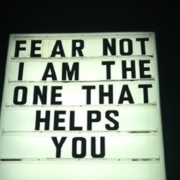
I rounded the corner and started up Main Street, lined with silent boutiques and artisan coffee shops. Suddenly ahead of me appeared a sign, brightly lit. In bold black letters were the words, FEAR NOT, I AM THE ONE WHO HELPS YOU. Was I dreaming, seeing this sign in the middle of the night? No doubt it was a message from God that He saw me and would help in the coming days. I took a picture, found courage in the moment, and headed back towards the hospital.

Thank you, Lord, for giving us signs–especially in times of desperate need. 

Reflect: What signs of encouragement has the Lord given you along your caregiving road?  Keep a watch this week for evidence of his loving care.


The above selection is Entry #8 in Part I: Unexpected Fall of Minding Mom: A Caregiver’s Devotional Story by Lisa Livezey (© 2024, En Route Books and Media)

Minding Mom: A Caregiver’s Devotional Story by Lisa Livezey | En Route Books and Media

Cup of Tears, Cup of Joy

Cup of Tears, Cup of Joy


Twelve years ago, I was in the hospital, recovering from an atypical total knee replacement, and feeling sorry for myself because I didn’t make it to the bathroom in time. My tears could have filled a cup, even though I was in a comfortable room, getting great medical care, and had plenty to eat and drink. What did I have to cry about? The pain? The dependency on others? The embarrassment?

When I caught sight of the TV screen just inches away from the crucifix, I stopped crying: I watched a commercial with an emaciated woman clinging to her skeleton-like baby as she reached forward with an old tin cup in her hand. Dehydrated and dying, this woman was holding out hope and joy that her cup would be filled with milk for her child.  

Fast-forward to a month ago when I joined my cousins in one of many shanty towns in Cebu, Philippines, to distribute school supplies, clothing, and treats for the children. As we navigated leaving along the narrow pathway, I spotted a little girl with toothpick limbs as she stopped to drizzle water over her bare feet from a makeshift spigot before she entered one of the shacks. She smiled amid the stench and garbage, happily holding her “gifts.”

As I think of Christ on the Crucifix and the suffering He endured out of love for each of us, I remember the joy of a fragile mother and an impoverished child and feel somewhat ashamed of the tears I shed over so many seemingly trivial trials. God gets me, and I am consoled by the Psalmist’s conviction:

“He heals the brokenhearted and binds up their wounds.” —Psalm 147:3

My prayer is to cultivate the strength to give up my cup of privileged tears and replace them with a cup full of joy and gratitude taught by a mother and a young child. As the new year progresses, may your cup of tears be filled also with hope, joy, and gratitude.

“…weeping may stay for the night, but rejoicing comes in the morning.” —Psalm 30:5

© Paula Veloso Babadi 2025

Edited by Gabriella Batel

__________________________________________________________________________________

When she is not playing pickleball or “Nana,” Paula Veloso Babadi cooks, gardens, and writes poetry and short personal essays. You can find her first book-length collection, Everywhere Hope, on Amazon.

Announcing Alzheimer’s

Announcing Alzheimer’s

By Lisa Livezey

Do not boast about tomorrow, for you do not know what any day may bring forth.

– Proverbs 27:1 (NAB)

I stopped by my parents’ split-level suburban home for a quick visit and Mom met me at the door. “Lisa, I have ALZHEIMERS!!!!” she pronounced with angst. Dad stood in the background smiling tenderly.

The news was no surprise. In fact, Mom had announced her diagnosis to me three times already.

In a flash moment, I considered Mom’s exemplary life. She was a faithful wife, mother and grandmother, a registered nurse, volunteer librarian, had taken in foster children, kept an immaculate, organized home, and even led Bible studies.  She doted on her grandchildren, who hold happy memories of time spent at “Gigi and Pop’s” house along with weekends camping in the mountains.

Now at age 82, Mom was descending from the mountains and gazing despairingly upon the wilderness of Alzheimer’s disease.  For one so capable, no doubt the future appeared bleak and scary.

Giving her a hug, I said, “Don’t worry, Mom. It’ll be okay.”  Surely God would provide the daily help she needed, just as He had during her more productive years.

I knew Mom was in good hands with Dad’s stabilizing presence beside her. He capably handled Mom’s health issues and certainly would be her continued comfort and guide amidst the changing landscape of her brain.

Lord, Thank you for today. I know not what tomorrow holds, so help me to trust You with the future.

Reflect: Think about loved ones in your life who are experiencing change due to age or illness and offer up a prayer for each one.


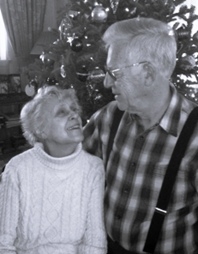
The author’s parents, Christmas 2016, six months
before “Announcing Alzheimer’s” took place

___________________________________________________________

The above blog piece is the Prologue in Minding Mom: A Caregiver’s Devotional Story by Lisa Livezey (© 2024, En Route Books and Media)

Minding Mom: A Caregiver’s Devotional Story by Lisa Livezey | En Route Books and Media

Listen to the audio version of “Announcing Alzheiemer’s” read by the author.


Copyright 2025 Lisa Livezey

The Power of a Smile

The Power of a Smile

When my kiddos were young, the local YMCA was a saving grace. My four daughters, ages four and under, loved playing in the childcare area almost as much as I loved a chance to pee uninterrupted. My mom-friends also belonged to the Y, so it was as much a playdate for me as it was for the kids.

At the YMCA, I learned that I do actually enjoy working out when it’s not a mandatory school class. I took various group classes that met my social needs and allowed me to try new exercises with no pressure or obligation. I remember especially fondly that if it weren’t for the YMCA, I may not have showered at all when my husband traveled for work. My twins are cute, but I couldn’t take my eyes off them for a minute!

Naturally, when I learned that my husband’s job was moving us to a new state, one of the first things I searched for was if our new town had a YMCA. To my great relief, it did. I’m fairly sure the girls and I trekked over there to become members on our second day there.

But everything was wrong with the new Y. My kids were scared of the new childcare area because they didn’t know the staff yet. They didn’t offer my favorite exercise classes. The cardio room was separate from the weights room, and both felt cramped: the building was regularly crowded, and my preferred machines weren’t available; I had to sign up for a turn on the cardio equipment and could only do thirty minutes at a time.

The worst part was how unfriendly everyone was, from the staff to my fellow patrons. I didn’t know anyone, and no one talked to me. Aside from a quick greeting as I dropped off my kids in the childcare area, I wouldn’t speak to a single person. I distinctly remember feeling profoundly alone while surrounded by people. They just weren’t my people.

One day, while I moped around the YMCA, bemoaning how I didn’t have any friends or even get a friendly smile, I realized the fault was mine. I recognized that from the moment I put the car in park, I hung my head and only looked at the ground. It was no wonder no one ever smiled at me. I didn’t give a single person I passed the opportunity.

At that moment, something changed in me. I decided to not be the reason for my own misery. I decided to lift my head, look everyone I passed in the eye, and smile. The most amazing thing happened: people smiled back.

I felt less alone from that day forward, not because I immediately made friends (which, I’m sad to report, didn’t happen overnight) but because I was connecting with other human beings. God created us in His image and likeness, and He created us for relationships. We aren’t meant to go through this life alone.

I learned some valuable lessons from that experience, the most notable being that I am responsible for my behavior. I can’t begrudge the unfriendliness of others when I don’t make the effort myself; something as small and simple as a smile can make a huge difference.

When I walk around looking people in the eyes and smiling, my soul is transformed. Even if I’m struggling and my life isn’t as simple and easy as I’d like, when I smile, I allow the joy that Christ offers to penetrate into my heart. What’s more, my smile is returned more often than not with a smile from a stranger’s face, further filling my soul with happiness.

These days, I don’t have to think about it: I’m always smiling. I love looking at other people and greeting them warmly. Each person I pass is a fellow creation of God, and I am blessed to be in her or his company. My kids often comment on how friendly I am—I get a chance to remind them that every person we pass has dignity and worth, regardless of her or his outward appearance. In this small, simple way, I get to share Christ’s joy with others.

If you’re feeling down or isolated, the most powerful tool you have requires only a few muscles in your face. It’s guaranteed to make you feel better, and chances are, your joy will spill into the strangers you pass. All you have to do is smile.

©Maria Riley 2024

God’s Christmas Wish

God’s Christmas Wish

Finding myself deep in the throes of holiday madness recently, a short phrase spoken by a house guest caused me to stop and think about where my focus is this Christmas Season.

“We want as much as we can get. All dogs want are the crumbs.”

Among the busyness that comes with the holidays are many suggestions for the gift-giving season. As a child, I recall giving my parents my gift wishes in not-so-subtle ways. I circled toys in catalogs and newspaper ads, as a blatant way of letting them know all I hoped for that Christmas. I have lovely memories of how my children voiced their wish lists, and I am enjoying how creativity is growing with each new generation.

Fixing our eyes on the birth of Christ becomes complicated when the commercialization of Christmas is all around us. Somewhere, at some point, there needs to be a balance. After all, God gave us the best Christmas gift ever, and doing the same for our families is good. Keeping our hearts aligned with God in the process is even better.

I never imagined such a profound statement coming from giving our dog apple pie crumbs. The truth in those words echoes in my heart days later. At this time of year especially, we do want as much as we can get, and if you think about it, the little dog considers the crumbs a full-course meal. I don’t think I will ever look at a piece of apple pie the same, and if my little dog plays her cards right, she may end up with a whole slice!

What would this look like if we flipped the circumstances just a little? Would crumbs be enough in everything we pray for or desire from God? If God’s will for our lives is not to receive the wish list in our minds but to receive only a portion, can we be as content as the dog receiving scraps? Taking it even one step further, let’s imagine that we are holding the meal, and God is patiently waiting for us to give Him a portion—how much are you willing to give God? Are you offering only crumbs or the entire piece?

A relationship with God requires opening your heart and giving God your time and energy. We put forth all of these things to the multitudes during the holidays. I never think twice about making time for shopping, baking cookies, and attending holiday gatherings. However, there are times when my prayer life suffers amidst the holiday madness. Christmas is a celebration of the birth of Christ, God’s one and only Son, given to us as a gift. It is a beautiful gift for you and me to offer our time, energy, and focus to the God who gave us life.

So how do we find that balance, the sweet spot where we can check off the holiday to-do list while staying true to our commitment to the intimacy of prayer? The obvious would be to put God first. This is easier said than done when our minds focus on everything else. Perhaps a written wish list between you and God might do the trick. Consider what God might wish for you, and then offer your requests prayerfully each day. Actions such as these will help to keep your heart and mind focused on involving God in the holiday preparations.

As you wrap presents and tie beautiful bows this holiday season, offer a prayer or two for God’s children who are happy and content with what little they have. Pray for the desire and grace to be satisfied with what God has given you, and perhaps drop a crumb or two to the little dog waiting at your side; God is right there with them.


Copyright 2023 text and dog photo: Kimberly Novak
Other Images: Canva


Navigating through darkness to the Season of Light

Navigating through darkness to the Season of Light

My peace I leave with you, my peace I give to you. Not as the world gives do I give it to you. Do not let your hearts be troubled or afraid.
—John 14:27

The Lord spoke these words to disciples before the crucifixion. By the end of the discourse, it would be understandable that their anxiety was rising. He concluded: “I have told you this so that you might have peace in me. In the world you will have trouble, but take courage, I have conquered the world” (John 17:33). He knew what the earthly powers planned for them as his followers, and they needed to be reminded that no matter what the world dished out, his was not simply a better way, but the best way. He also sent this message before his birth. In reflecting upon the readings throughout Advent, we can quell the turbulent stirrings rousted during the holidays.

Living in the world is a hard contact sport, and only a fool would play a rough game without proper conditioning and back-up. Yet so many go through life without the support that faith gives. Our society has record numbers of people living with anxiety and depression, and plummeting numbers in church attendance and religious affiliation. The culture is identified by the disturbingly accepted phrase, “post-Christian society.”

Even believers can be shadowed by the unrest that balloons during the Advent and Christmas seasons. The constant pressure to spend, eat, socialize, and “be of good cheer” causes angst for many, even those who enjoy the hustle and bustle. The Devil, that slobbering, panting mongrel of darkness, dispatches four of his best henchmen to squeeze the vulnerable. These days, that applies to most of us. Anxiety, Panic, Fear, and Depression are among his supreme lieutenants because they are excellent collaborators of opportunism. He recruits limitless holiday help to brew botheration through the urgent and endless “best sale of the year” deals, the “get it or forget it” Christmas lists, and social engagements (or lack thereof).

For others, the season stirs up grief over deep loss. The reasons for the unease outnumber the people experiencing them. The pace of keeping up with the season triggers everything from dread to disappointment to despondency. It’s enough to make Santa’s elves want the holiday season to be done. How sad to want such a beloved and beautiful time—Advent and Christmas—to be over with a big sigh of relief. For the beast of the underworld, it’s pure delight, like fresh, bloody meat.

Scripture is always the balm for sufferings of the world, but the readings this Advent—including those from morning and evening prayer and daily Mass—penetrate the fog that can become ever so dense. We began Advent with the command to “watch.” Listen also to the messages of the season. Perhaps commit to memory a passage to push out the anxiety whenever it begins to bubble. “I will listen for what God, the Lord has to say; surely he will speak of peace to his people and the faithful” (Psalm 85:9).

During Advent, we encounter the faceless and the nameless that Jesus healed, proving that God sees us all—no matter how invisible we may feel—and wants to make us whole. “Great crowds came to him, having with them the lame, the blind, and many others. They placed them at his feet, and he cured them” (Matthew 15:30). Matthew recounts in 9:36: “At the sight of the crowds, his heart was moved with pity for them because they were troubled and abandoned, like sheep without a shepherd.” He even healed those not physically present as we hear the centurion’s pleas for his suffering, paralyzed servant (cf. Matthew 8:5-13).

We meet people this month who, with great trials, embraced the rays of the Son. December 13 is the feast of the fourth century martyr, St. Lucy, whose name means light. She chose a hideous torture that blinded her because she would not betray her Savior. Isaiah 40:29 fortifies us: “He gives power to the faint, abundant strength to the weak.” The following day, December 14, we remember St. John of the Cross who, more than five centuries later, continues to enlighten with his Dark Night of the Soul.

The Advent readings are a treasury of fortitude to battle distress: “… you shall no longer weep; He will be most gracious to you when you cry out; as soon as he hears, he will answer you” (Isaiah 30:19). And others: Psalm 121:5, 7-8; Isaiah 25:8; Wisdom 18:14-16; Song of Songs 2:10-11 to name a few. Throughout Advent, God sends us messages of hope and encouragement. We are assured in Philippians 4:6-7: “Have no anxiety at all, but in everything by prayer and petition, with thanksgiving, make your requests known to God. Then the peace of God that surpasses all understanding will guard your hearts and minds in Christ Jesus.”

Peace be with you.


Copyright 2023 Mary McWilliams

Feature Image by Rúben Gál from Pixabay
Image by Ri Butov from Pixabay