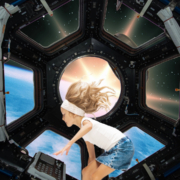

Grab Me a Coke and a Character

“Grab me a Coke,” my husband said over the phone, as I was driving home from work. He drinks a Coca-Cola at least once a day and skipping it feels like withdrawal, so I stopped at the Navarro store a few blocks from home.

When I put my things on the register, the cashier leaned toward me and said, “Can you imagine this lady is eighty-one?” She was referring to a woman standing next to me, putting her change away in her purse.

Because I was prompted to judge this woman based on what a typical eighty-year-old might be like, I gave her a second look, a closer look. The woman looked really good for her age. She had great skin, a flawless complexion, not a wrinkle on her face. She wore a long fake brown ponytail and had perfectly painted-on eyebrows, not what I would expect from an eighty-year-old with shaky hands. Perfect arch. Filled in. On point.

“Wow, you look great,” I said in Spanish.

She laughed and went on to brag about her many boyfriends (younger ones at that) and about women who accused her of looking at their husbands. She boldly replied, “That’s how I like my men… married.” It was a lot of information to dump on a stranger at the register and definitely unexpected from an elderly woman. She shrugged and said she had several boyfriends, and why not? Men have two, three girls, and no one says anything to them. She clearly didn’t like the double standard. At her age, she knew who she was and felt confident sharing it.

If it were me, I would have written her as a little old lady quietly counting her change in her coin purse and walking home to watch telenovelas until she fell asleep, not the main character of one. Who would have guessed she still had a libido, an appetite for younger men… married men, and was unapologetic about it?

If I hadn’t been asked to take a second look, I would have cast her as an extra in the grocery store scene: (Abuela putting coins into her pouch). I had unconsciously boxed her into a role before she ever spoke.

The Danger of Catholic Writing

As a Catholic writer, I struggle to write characters who behave badly. I want to write moral characters. I don’t want readers to think I’m condoning bad behavior, and when I do write about characters behaving badly, I often box them into the villain role. But why can’t they be the protagonist?

In the Gospels, we encounter many flawed characters, and the narrator doesn’t pause to explain or moralize. There are no footnotes saying, “Don’t do what this person did.” We’re simply told who they are: a tax collector, an adulteress, a denier, a betrayer for thirty denarii.

Some become saints. One becomes a traitor we pity. What makes these stories powerful is that these characters are human, complex, contradictory, not flat and predictable.

Even great writers who write about the authentic human experience receive backlash. Zora Neale Hurston, both a writer and anthropologist, wrote people as they were, not as archetypes, not as political statements, not as moral lessons. Some criticized her use of dialect and portrayal of Black life in the South, but she didn’t care. She wanted to write people, not politics.

As writers, we can fall into creating characters to serve agendas, for preaching, teaching, or moral messaging. The bad guy has a foul mouth, a scar through his eyebrow, tattoos, a raspy voice. But what if the good guy did?

What I Learned from the Diva Eighty-Year-Old at the Register

I learned to accept her, not judge her, to accept that there are eighty-year-old women who still feel sexy and live life on their own terms. I’m not condoning her behavior, but I value her confidence and her refusal to fall into society’s idea of a well-behaved woman, or grandmother.

People are interesting, and so should our characters. God does not reduce us to stereotypes. He sees us truthfully, beautifully, and with dignity, in all our complexity and contradiction. As writers, we’re called to see people the same way.

Ask yourself:

  • Has my character fallen into a stereotype?
  • How can I write flawed characters, even antagonists, with dignity?
  • How can I write surprisingly flawed protagonists?
  • Where is the contradiction in this person?

Reflection

When I first saw the eighty-one-year-old woman, I saw a hunched-over elderly woman counting her change. But when I was stopped and asked to give her a second look, I was the one dealing with change. A revelation was made to me: people are wild cards, and so should be our characters. Her anecdotes replayed in my mind as I walked away with a Coke and a smile.


copyright 2026 Janet Tamez

Pilgrim Tales: The Glorious Pilgrimage of Margaret Henderson

Margaret Henderson, or Mama Mags as she was affectionately called, had been a shining example of feminine genius—faithful, organized, empathetic, and calm—for as far back as Veronica could remember. – “The Glorious Pilgrimage of Margaret Henderson” 

 “The Glorious Pilgrimage of a Margaret Henderson” was inspired by the bravery of my elderly parents after the sudden death of one of my brothers in a car accident. They signed up for a European pilgrimage! My mom had flown to Florida once or twice, and both of my parents had gone to Vegas, but they had never flown across an ocean. To learn that they were going to France, Italy, and Spain was shocking. To think they had saved that much money after beginning their family in the Depression and raising eight children on one income, and not a very high income at that, was unbelievable to twenty-one-year-old me. 

Upon their return, they were on cloud nine, eager to tell of their experiences, especially of being slain in the Spirit while in Lourdes. They invited each of their married adult children to their home to share this, some of whom had fallen away from the faith. It should have held more weight than it probably did, especially because of my convert dad’s profound feeling that only God could do that. I remember being skeptical of it myself, as I had never heard of such a thing happening. Still, the memory stuck, and my parents’ pilgrimage adventure instilled in me the desire to travel to Europe and visit the holy places of all those saints I learned about during my years of Catholic elementary school. 

After my dad’s passing, my mother embarked on another pilgrimage with my godfather’s wife, and two more compatible travel buddies would be hard to find. My godfather’s family has always been considered an extension of our family. So much so that their daughter, Lucy, is the inspiration for the character of David in my anthology story. Anyway, my mom and her dearest friend joined a tour group and headed to Germany, Austria, and Switzerland. Being half-German, my mother brought back gifts from that country, such as an authentic beer stein, ivory-carved mini-statues of angels singing, and hand-embroidered doilies with crocheted cotton lace. 

Margaret Henderson is only a tiny bit like my mom. The main inspiration for that genteel character is a combination of three graceful women outside of my family, as well as from the faith I witnessed at the more recent passing of my ninety-four-year-old brother-in-law. He seemed ready, as if he had prepared for death all his life. 

Last year, my husband and I were privileged to spend 42 days in Europe in various parts of Ireland, France, and Italy. We ended our time with nine days in Rome. We had no idea we would love the Eternal City so much! A highlight of our European journey was the dozens of Catholic churches we were privileged to walk into. We cherish the time we had to admire, dream, reflect, and pray. The whole adventure turned into our very own pilgrimage, and we give God all the thanks and glory for it! 

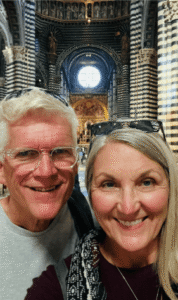
A selfie of the author and her husband in a Catholic church in Sienna.


The Thayers in Siena (October 2024). St. Catherine of Siena is Mary Jo’s Confirmation saint.


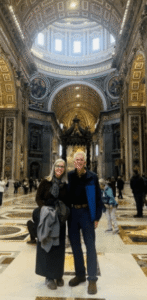
A picture of the author and her husband in St. Peter's basilica.

The Thayers inside St. Peter’s Basilica (November 2024) after having attended Sunday Mass celebrated by Pope Francis and then praying the Angelus with him in St. Peter’s Square.


Read “The Glorious Pilgrimage of Margaret Henderson,” and other short stories by the Catholic Writers Guild in Pilgrim Tales: a Catholic Writers Guild Short Story Anthology available now on Amazon in print and e-book.

Feature Photo: Pixabay

© Copyright 2026 by Mary Jo Thayer


Edited by Rietta Parker

Pilgrim Tales: Kyrie

“I had taken the first steps on my pilgrimage, a pilgrimage that was only just beginning…Kyrie eleison.”

The Quick and the Dead

“He will come in glory to judge the living and the dead,” reads the Nicene Creed, or as we used to say, “the quick and the dead.”

The words resonated with me more than usual, following a series of losses over the past couple of years. First, my mother, then my father, and lastly my German Shepherd, Rex, my heart dog, passed away.

The quick and the dead. What could I do with those words? Surely a basis for a story – or a series of stories – lay within that short phrase. As I mulled it over, the “quick” became Jonathan Quick, a bereaved composer, and the “dead” became Meredith de’Ath (spelled like “death” but pronounced “Deeth”), his recently deceased fiancée. 

I have long enjoyed reading and writing ghost stories. So Meredith became a ghost, though not a haunting revenant, but returned by the grace of God to guide the faltering Jonathan to perform various works of mercy and restore him to faith. Hence, the title of the first of what has become a series of stories, “Kyrie”. Lord, have mercy.

Both Jonathan and Meredith are on pilgrimage – a pilgrimage to heaven. Jonathan in this life, Meredith completing her pilgrimage in the next – returning from purgatory, perhaps.

“Kyrie” takes place in England because I am English and enjoy writing stories set in my homeland, sometimes using locations that I have visited as background.

We, too, are on pilgrimage, and “Kyrie” illustrates the unexpected twists and turns our pilgrimages may take and how we might be surprised by the mysterious and unfathomable mercy and grace of God. 


Copyright 2026 by Andrew M. Seddon

Edited by Paula V. Babadi

Photo credit: Trek_Jason, Pixabay

Read “Kyrie,” and other short stories by the Catholic Writers Guild in Pilgrim Tales: a Catholic Writers Guild Short Story Anthology, available now on Amazon in print and e-book.

E-book: https://www.amazon.com/dp/B0G5VZ7WV8

Print: https://www.amazon.com/dp/B0G5WZF1PV


Pilgrim Tales: The Story Behind “Faithful Journeys, Hidden Sanctuaries”

They stood in silence for a moment, the old man and the young, united by faith, by craft, by blood, and by the shared knowledge of what it meant to be touched by something beyond understanding. -“Faithful Journeys, Hidden Sanctuaries”

When invited to contribute to the CWG Anthology, I was happy for the opportunity to write a historical fiction story as a way to learn about the saints. In particular, a group of saints that we learned about while traveling through England this past winter. 

We expected our visit to York to be about Yorkshire pudding and Vikings. Instead, we learned of the extraordinary courage of people who risked everything to practice their faith, the  Forty Martyrs of England and Wales. Among them was Margaret Clitherow, the “Pearl of York,” a wife and mother who hid priests in her home and died under torture rather than betray them.  

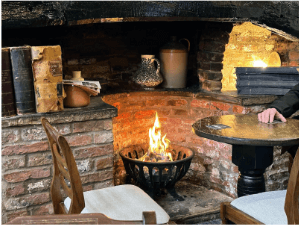
Our first stop was The Red Lion pub for lunch.  Besides steak pie and real ale, this medieval pub featured a priest hole. Further research revealed the remarkable tale of Nicholas Owen, a carpenter whose genius for concealment saved countless lives through his construction of priest holes—those hiding places built into the walls, floors, and chimneys of Catholic homes during the persecution in Elizabethan times.

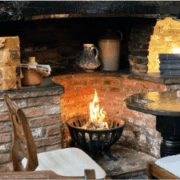
Picture of a bread oven circa 1300s- brick surrounding a fire pit structure

Bread oven circa 1300’s at The Red Lion pub in York. Photo credit: John Ruberto


These two figures captivated me, and I knew I wanted to honor them in fiction. But how do you tell this story? St. Margaret Clitherow held secret Mass at her home, protecting so many Catholics in York, and St. Thomas Owen, who operated in Oxford, built over one hundred priest holes across England before his death by torture in the Tower of London. They were separated by time and distance. 

That’s when the pilgrimage tradition entered my imagination, to tie in another amazing experience traveling through Great Briton. 

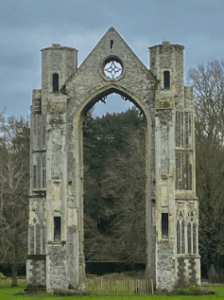
 Our Lady of Walsingham had been England’s greatest pilgrimage site for centuries before Henry VIII ordered its destruction in 1538. What if a young Nicholas Owen—grieving, questioning, struggling with faith—journeyed to the ruins of Walsingham? What if that pilgrimage became the crucible where his calling was forged?

Picture of the ruins of the Priory in Walsingham - looks like a giant stone castle-like arch with lush greenery in the background

Remains of the Priory in Walsingham, once a great pilgrimage site in England.
Photo credit: John Ruberto

The resulting story follows a fictionalized Nicholas on a journey from Yorkshire to Norfolk, encountering Margaret Clitherow along the way. It’s a coming-of-age tale set against the dangerous backdrop of Elizabethan England, where celebrating Mass could cost you your life and harboring a priest meant death.

Through Nicholas’s eyes, we see how pilgrimage—even to a destroyed shrine—can transform a heart. We witness how grief can become purpose, how craftsmanship can become ministry, and how ordinary people become saints not through grand gestures but through faithful, hidden service.

“Faithful Journeys, Hidden Sanctuaries” appears in the anthology Pilgrim Tales, celebrating the tradition of Christian pilgrimage through fiction. It’s my small attempt to remember those who built secret sanctuaries and kept the faith alive through England’s darkest era.


John Ruberto and his wife, Laura, write about their pilgrimage experiences on their blog, The Hallowed Way

Read “Faithful Journeys, Hidden Sanctuaries,” and other short stories by the Catholic Writers Guild in Pilgrim Tales: a Catholic Writers Guild Short Story Anthology available now on Amazon in print and e-book.

Feature Photo by John Ruberto

© Copyright 2026 by John Ruberto


Edited by Rietta Parker

Pilgrim Tales: What is a Pilgrim?

We both know you can’t make someone believe in God and religion, so I think I got the better end of the deal. -“Pilgrim in Name Only”

In walking the Camino de Santiago and later the Via Francigena, my husband and I quickly realized that we were some of the only ones walking for the original purpose of a pilgrimage – “a journey to a sacred place undertaken as an act of religious devotion.” Most pilgrims today take these ancient religious routes for a variety of non-religious reasons including adventure, travel, nature, reflection, exercise, history, culture, and camaraderie. While about 35% – 45% of pilgrims say they had mainly religious motivations, it is important to note that for the Camino, one must state a “spiritual” reason in order to obtain the coveted completion certificate (Compostela). In talking to pilgrims enroute, it seemed far fewer folks than this had pious purposes in mind.

The non-religious reasons people go are all good, and I am not finding fault. Yet, as a veteran pilgrim, I know their pilgrimages could be more deeply fulfilling if they partook of all that there was to experience along the way. There we were on a path literally filled with churches, monasteries, and shrines of timeless sacred art and architecture. That kind of beauty speaks to the soul! Often we were the only ones stopping at them. Our fellow hikers professed ignorance or indifference if we mentioned entering a church – even the Christians. It seemed not much thought was given to their habit of just passing by these holy places. Thousands of opportunities were being wasted.

It stayed on my heart that a considerable number of “pilgrims” were missing out from a faith perspective. They were of course pilgrims in one sense but not in the original sense- not in the sense that had the potential to transform their lives.

And so, I decided to explore what kind of transformation a non-religious recent college graduate pilgrim might go through in making the 1,240-mile Via Francigena if he had some “rules” to follow as he hiked. What might it take to open his heart just a bit? Enter his beloved Catholic uncle who offers his classic Alfa Romeo as the motivation for his insecure lazy, yet well-meaning nephew, and creates the list of rules including keeping a journal, doing an act of kindness, and sitting in a church 10 minutes each day. In a nod to my mom’s heritage and my dad’s talent, the uncle is a wise big-hearted Sicilian and a winning wrestling coach.

Sure, I wanted our hero to get the car, but more than that I wanted him to experience the richness of the faith all around him. Will he tear up the list in frustration? In traversing four countries and rugged terrain, how will he hold up? Who will he meet? Will his outlook be different afterwards? Is he just going through the motions to get the prize?  

One thing is sure, like every pilgrimage, his will not go quite as planned.

Laura Ruberto and her husband John blog about pilgrimages and more at hallowedway.com.

Read “Pilgrim in Name Only,” and other short stories by the Catholic Writers Guild in Pilgrim Tales: a Catholic Writers Guild Short Story Anthology available now on Amazon in print and e-book.

Feature Photo by Laura Ruberto

© Copyright 2026 by Laura Ruberto


Edited by Rietta Parker

Pilgrim Tales: The Day the Dome Dropped on my Head

Even being on a pilgrimage, sometimes it felt like the emphasis was more on the stops than on stopping. –“The Day the Dome Dropped on My Head” 

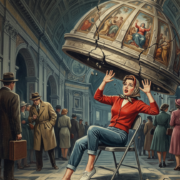
The title “The Day the Dome Dropped on My Head,” has the ring of a 1950s pulp fiction paperback, but reflects more of a supernatural experience that happens in a well-known Roman church and culminates in a spiritual conversion.

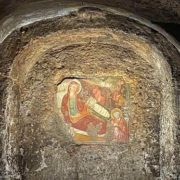
“Maria e Gesu”, a dome-like 13th Century mosaic by Pietro Cavallini, is the center and most prominent art in the apse of the Basilica of Santa Maria in the Trastevere section of Rome. For our protagonist in the story, the experience is not an example of enlightenment through Visio Divino – meditation on art of a spiritual nature that results in a
breakthrough understanding. In fact, nearing the end of her pilgrimage, she is overcome with an ennui of all the ancient mosaics and tapestries the pilgrims had seen with little opportunity to take in all their significance. She doesn’t even see it. Rather, it becomes an interaction with God who put His hand out to her as answer to a pleading prayer.

That hand in the mosaic is around the shoulder of His mother, as though to reassure and guide her. It rests gently around her shoulder, the tips of His fingers peeking around her shoulder. He is not tugging, pulling, controlling or weighing her down. She leans into Him ever so slightly, and her left hand gestures toward Him. It’s as though they both are saying to each other, “You are mine,” but they look ahead.

To beckon the rest of us? Or, in the case of the protagonist, to find us and reach out?

She learns that He has been with her during her whole life.

He was with her when she thought she was completely alone.

He was the one who saved her from herself.

The Basilica’s website is the best place to view the mosaic and learn its meaning as intended by the artist. The Basilica’s website, at this writing, appears down, but many visitors have shared their videos experiencing the art, architecture and history on YouTube. They offer a glimpse not only of Maria e Gesu but of other breathtaking and inspirational images. Exciting Europe offers a brief video with several close up shots of the mosaic beginning at 4:26. At 5:42, Chris Channel moves in to the image, resulting in a very fast but very close view. Finally, Makc Markc, has a great gradual close-up from minute 1:28-1:56.


Read “The Day the Dome Dropped on My Head,” and other short stories by the Catholic Writers Guild in Pilgrim Tales: a Catholic Writers Guild Short Story Anthology available now on Amazon in print and e-book.

AI Feature image generated in Adobe Firefly/Gemini 2.5 with Nano Banana by Mary
McWilliams

© Copyright 2025 by Mary McWilliams


Edited by Rietta Parker


Pilgrim Tales: God of the Unexpected: A Pilgrim’s Romance

There was only one person who could motivate me to do something so ridiculous as to set off for a hike through the mountains before dawn: Jeremy. -“Pilgrim’s Romance”

I fell in love with Bernadette’s story the moment it popped into my head. At 9:00AM. On the morning of the anthology submissions deadline. Yikes!

I’d always been one to do things last-minute, but that was cutting it close, even for me. Truth be told, I’d written off participating in the anthology, because it was for short stories. Until that day, I’d never written a short story that hadn’t ballooned into a full-fledged novel—or a multi-book series. Brevity has never been one of my gifts. So write a short story? Me? That was a funny joke.

But God has a sense of humor.

See, over the years I’ve noticed this pattern… Maybe you’ve experienced it too? How God likes to look at our lists of “Things I Will Never Do Because (fill in the blank with our insecurities),” and then proceed to ask us to do them. It seems He takes great delight in calling us to things that we are only capable of accomplishing with His help. When we write ourselves off, He holds out His hand, smiles a somewhat mischievous smile, and says, “Trust Me.”

Translation: Watch this.

When Pope John Paul II said that “Life with Christ is a wonderful adventure,” he wasn’t kidding! Some of the best—and hardest—things God has ever called me to have been things that I would never have been capable of doing without His constant provision. It’s an exciting way to live, though honestly, it isn’t easy. Still, it has always been worth it.

Bernadette has a chance to step forward into her own adventure in “A Pilgrim’s Romance,” trusting God in unexpected ways. No surprise, JPII has his own little part to play in her story as well. The hiking pilgrimage she and Jeremy take is named after the beloved saint, who himself often took young people on hikes up into the mountains while he was still a parish priest in Poland during the Communist regime. Then Fr. Karol Wojtyla had a deep love for youth, and a passion for calling them to greatness—something he never lost when he became Pope John Paul
II.

I was deeply inspired by him when I was a teenager and young adult, and felt that call to greatness through his words and example. I firmly believe he has been praying for me for the past twenty years, and it is no accident that my first—somewhat miraculous—short story includes a group of young people hiking with their pastor. I didn’t plan it that way, but I surrendered my “I can’ts,” and it turned out far better than I ever expected.

Isn’t that just how God works?

Read “A Pilgrim’s Romance,” and other short stories by the Catholic Writers Guild in Pilgrim Tales: a Catholic Writers Guild Short Story Anthology available now on Amazon in print and e-book.

Feature Photo by Nancy Bechel
© Copyright 2025 by Nancy Bechel

Edited by Rietta Parker

Pilgrim Tales: Pilgrimage to L5

… Lucy and her mother aren’t just Catholic tourists. They’re seeking a new life after the death of Lucy’s father, and Lucy’s mom took them on this pilgrimage for help finding her new way forward. — “Pilgrimage to L5”


Churches were boring. And sad.

I’m tired of being bored and sad, she thought, casting her eyes upward. God, couldn’t something exciting happen?

Not everybody thinks pilgrimages are exciting. Eight-year-old Lucy Granger sure didn’t. In Pilgrimage to the L5 Space Station, she gets the chance to go to the home of the founder of the famous Rescue Sisters—St. Gillian of L5—on the anniversary of her sainthood, even. But it’s a lot of listening, looking, and praying, and she’d rather be doing something more exciting.

When the station’s cat leads her to the escape pod, she’s in for more excitement than she expects!

When CWG decided to make an anthology based on pilgrimages, I admit I was a little stumped at first. I’ve been on a couple of pilgrimages myself, but I’m a sci-fi writer. How could I make a pilgrimage in space—and even more, make it exciting in the way people expect sci-fi to be exciting?

I have a standard Catholic SF universe I write in: The Rescue Sisters (https://www.amazon.com/dp/B09L59B69G). This is a group of intrepid women religious who do search and rescue operations, run orphanages and hospitals, and work in safety capacities—all in outer space. My husband and I came up with the idea and we have six short stories and two books in the series so far, three of which are for children.

So I wanted to do another Rescue Sisters story for the anthology. The pilgrimage part wasn’t too hard. I had my own built-in-saint, St. Gillian of L5, founder of Our Order of the Rescue (a.k.a. the Rescue Sisters). It would be fun to return to her old stomping grounds. I’d already done an L5 story, “These Three,” so it let me bring some favorite characters back.

Next, I had to set up the rescue. What could be more natural than a bored child wandering off and getting into trouble? Toss in a cat who’s only too glad to help, and some fun complications, and that part was taken care of.

But what makes a Rescue Sisters story really good is the secondary plot—something tying into their identity not just as rescuers but as Catholics. That’s when I came up with the idea that Lucy and her mother aren’t just Catholic tourists. They’re seeking a new life after the death of Lucy’s father, and Lucy’s mom took them on this pilgrimage for help finding her new way forward.

I think the most life-changing pilgrimages happen when someone comes seeking a new way — a new way to live, a new way to love, a new way to heal.

Jesus said, “I am the Way,” yet how he leads us can be very different. Lucy’s mom finds her way—but in the course of her adventure, so does Lucy—and discovers church isn’t so boring after all.

Read “Pilgrimage to L5” in Pilgrim Tales: a Catholic Writers Guild Short Story Anthology starting this December on Amazon.

© Copyright 2025 by Karina Fabian


Edited by Mary McWilliams

What happened to the Virgin Mary?

Once there was a church that had the happiest people. They all worshipped together in harmony, young and old. They had many statues and one was a wooden statue of the Virgin and Child. One day the Deacon noticed that it was gone. Everyone was tasked with looking for her, but she was nowhere to be found and they organized a team of youngsters to find out what happened. They were Connor, Paul, Meagan, Alicia, and Linda. The committee of children went out to look for her.

They scoured the neighborhood and found the guilty party: a band of hoodlums. Connor asked them to give it back.

“No way,” said the chief hoodlum. “Only if you give us a ransom.” Connor thought fast.

“If we tell you a good story, can we get her back for free?”

“Ok” said the boy.

Each child set out to find a piece of the story that would bring the Madonna and Child back to the church.

Connor went looking around the neighborhood. He came across some people that were celebrating a gender reveal. One arch of pink balloons in the sky. It was beautiful. The parents were so happy as they looked around at their friends.

Paul tried to leave home to help find the statue, but before he could, his mother said, “Aunt Cheri is having her baby shower today and I can’t go. I have too much to do. Could you go instead? Here is your gift.”

“Ok, sure,” said Paul. He walked to his aunt’s house.

“So happy to see you, Paul!” Cheri said. The guests enjoyed hors d’oeuvres, played games like Guess the Name of the Baby, and opened gifts of clothes, baby food and toys.

Meagan went to St Luke’s hospital because she thought someone might have taken the statue for their patients. She passed by the baby ward and looked at the babies. They were so cute. She thought to herself “What if one of these was the baby Jesus?” It was hard to think of. Maybe Jesus would have had a golden aura around him, or maybe he would just look like an ordinary baby. She decided to tell the team that all the babies had a magical aura around them.

Alicia went back to the church to scour for the statue. When she was there, a crowd of people processed in. They filed in and the last ones were some proud parents with a baby in their arms dressed in white. They gave the baby to the priest who held it over the basin and said, “I baptize you in the name of the Father, and of the Son, and of the Holy Spirit,” while pouring water over the child’s head. She was fascinated with the process: a white glow seemed to emanate from the child’s clothes.

Finally, there was Linda, the youngest. She got a ride from her sister to the police station because she thought someone might have turned it in there. She sat down in the waiting room and shortly there was a huge uproar as some people excitedly came in. There was a young child with them and then a burst of joy from some other people as she was brought in. “Thank God, you found her,” they cried. There was much hugging and rejoicing. Then her sister told her it was time to go.

Each team member told the hoodlums their part of the story. When they were done, the hoodlum said “So that’s it?”

Connor said, “It’s the Joyful Mysteries: the Annunciation, the Visitation, the Nativity, the Presentation and the Finding in the Temple.”

The other group conferred and decided it was a good story after all. So that is how they all found the Virgin Mary.


©Copyright 2025 by Cecile Bianco

Featured AI Image generated in Midjourney.com by Mary McWilliams

The Shepherd’s Pie: Faith and Remembrance

The Shepherd’s Pie: Faith and Remembrance

“A slice of hope to raise faithful kids.”

This uplifting, ecumenical show uses engaging conversations and fun entertainment reviews to offer positive insights and media resources for families and youth leaders. We discuss current issues that impact young people at home, in school, and in the world today.

In this episode of The Shepherd’s Pie, Antony Barone Kolenc speaks with Father Jonathan Torres about his journey as a priest-author, and how the theme of remembrance is central to the Christian faith, and we discuss his fantasy novel, Blinding Dawn.


(info about this episode, get that here: https://anchor.fm/the-shepherds-pie )

Check out other episodes of The Shepherd’s Pie.

"The Shepherd's Pie: Faith and Remembrance" by Antony Barone Kolenc (Catholic Writers Guild blog)


Copyright 2025 Antony Barone Kolenc

Stay in the Know

Join Our Newsletter

Members and supporters can get the latest on CWG news and events by signing up for our newsletter.

Please wait...

Thank you for signing up!

Catholic Writers Guild
P.O. Box 77
Eaton, IN 47338